
Paediatric spinal assessment
Children are assessed differently from adults. During growth, posture, backpack load and screen use all affect the developing spine, and problems that are easy to address early become harder later. Assessment is age-appropriate and the approach is adjusted accordingly.
Understanding the problem
Why assessment during growth is different
A growing spine responds differently from an adult one. Postural habits established during school years — a heavy pack carried on one shoulder, hours bent over a screen, a chair the wrong height — act on tissue that is still developing, and small asymmetries can become established.
The flip side is that the same adaptability makes early changes easier to influence. Assessment during growth is mostly about noticing patterns early and changing the load, not about treating children like small adults.
What a first visit involves
How we work through it
We do not begin treatment on first meeting you. The assessment comes first.
- History — we listen firstWhere the pain is, when it started, what makes it worse, previous injuries, and your work and sleep posture. For accident or work injury cases, how the incident happened.
- Physical examinationPalpation, range of motion testing, and a neurological check of reflexes, strength and sensation — to work out whether the problem is structural, neurological or soft tissue.
- Digital X-ray if indicatedTaken on site. Whether it is needed is a clinical judgement, not a default for every patient.
- Findings and plan explainedIn the same visit you are told what was found, the likely cause, what is proposed and roughly how many visits it may take — before anything begins.
At the clinic
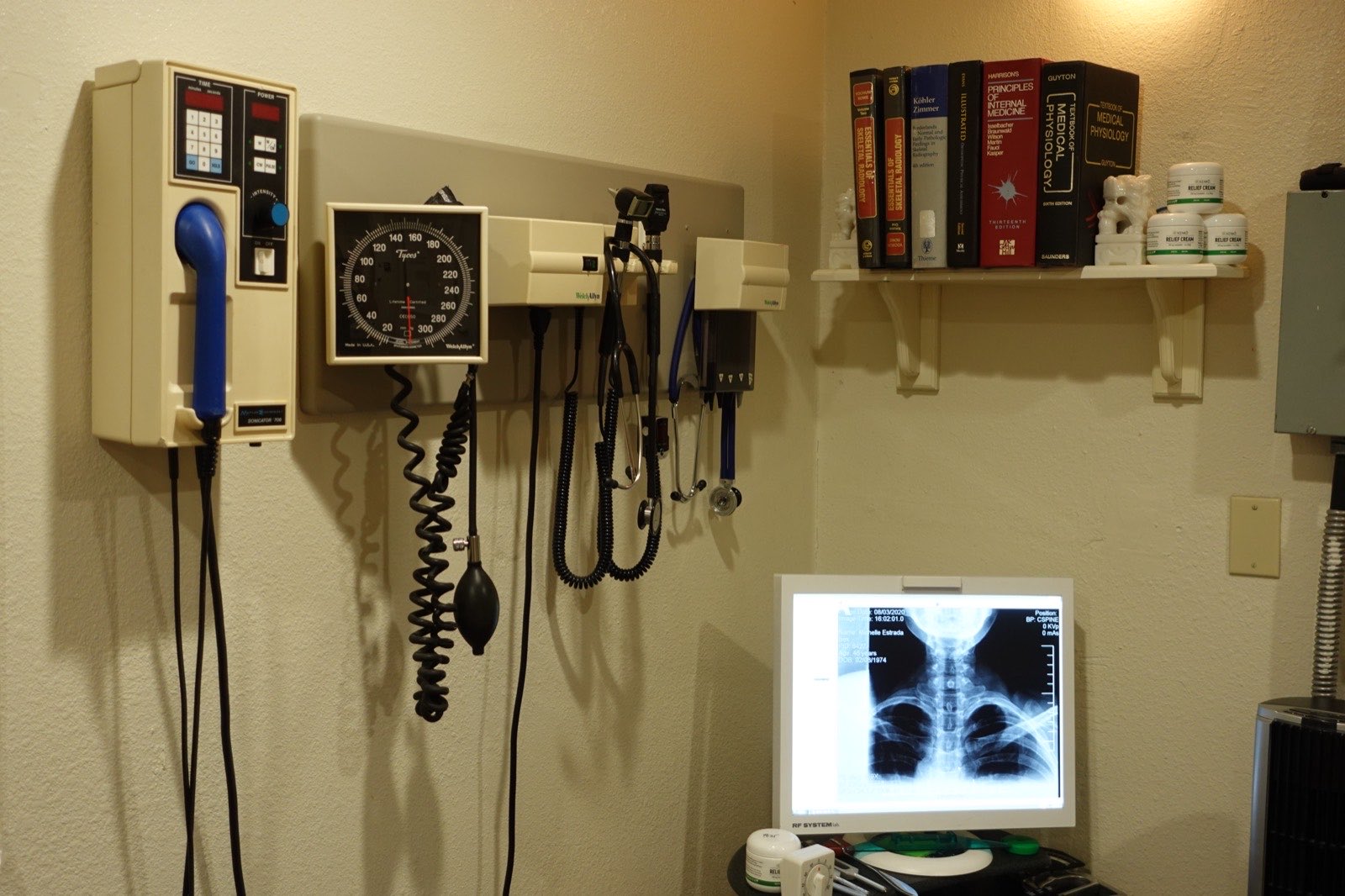
Treatment rooms and equipment
What may be used
Combined according to the assessment
Not every patient needs every item. What is used follows from what the examination shows.
- Age-appropriate postural and spinal assessment
- Screening for asymmetry and curvature
- Backpack weight and carrying advice
- Desk, chair and screen height advice
- Gentle age-appropriate treatment where indicated
- Exercise and stretching guidance for children
Fees and insurance
Who usually pays for this
How treatment is funded changes what paperwork you need. Pick the closest to your situation:
Auto accident
The at-fault driver's liability cover, MedPay on your own policy, or on a lien where you are represented.
What you need →Work injury
California workers' compensation — approved treatment is paid by the employer's insurer.
How it works →Private insurance
What PPO plans typically cover, and deductibles.
How to check →Self-pay
Self-pay rates, including initial examination with digital X-ray.
See rates →Why here
A few objective points
1988 — 38 years
Same practitioner, same Oakland Chinatown block since 1988.
Cantonese · Mandarin · Taiwanese · English
From history-taking to explaining the plan, in the language you are most comfortable in.
Digital X-ray, same visit
Where imaging is clinically indicated it is taken here, not at a separate centre.
5 min from Lake Merritt BART
Madison professional building, downtown Oakland. Building and street parking.

FAQ
Frequently asked questions
At what age can a child be assessed?
There is no fixed lower limit — what changes is the approach. Assessment and, where appropriate, treatment are adapted to the child's age and size.
Should my child be X-rayed?
Only where there is a specific clinical reason. We are more conservative about imaging in children, not less.
My child's backpack seems very heavy
It is a common factor. As a general guide, a pack carried on both shoulders and kept to a modest proportion of body weight is much better tolerated than a heavy one on one shoulder. We can go through it specifically.
Related
You may also need these
Request a call
Can't call right now? Leave a time and we'll call you
We book by phone. If now isn't a good time, fill in the form below and we'll call you during clinic hours.